Original letter from Dennis Brain
donated by Gavin King-Smith
"Craigmore,"
37 Frognal,
Hampstead,
N.W.3.21st October 1954Dear Mr. Munro,
In answer to your question, I feel that Mr. Forsyth is rather misleading, that is, if by the deep C he means the fundamental. If not, then I do not know what he means.
The fundamental is not certainly obtainable by any player with a slack enough embouchure, though it is impracticable on any crook below about G or F.
The fundamental most definitely exists but if it does not, then all the notes of the harmonic series which spring from it also would not exist.
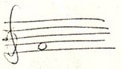
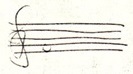
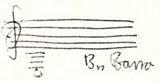
A little diagram over leaf may help, and one must also remember that as the muscles of the lips by their tension determine the pitch of the note produced, then for any given pitch the tension must be the same regardless of which harmonic it is at the time.
For instance
In F the harmonic used is the 8th, & in Bb it is the 6th yet the tension in the lip is exactly the same because the pitch is the same.
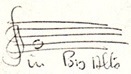
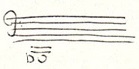
Now if
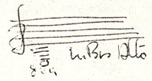
Yet in Bb Alto it is the fundamental a deep C, and in Bb Basso it is the second harmonic which proves that it theoretically and practically exists.
The low Bb in the second example is used on many occasions: for the second here at the opening of the 4th Symphony of Beethoven, and also in the Serenade of Britten at the end of the Hymn to Diana; the 4th movement and, as it is the fundamental on the Bb Alto crook, and in my recording is played as such, I think it answers your question.
To obtain the deep C on crooks lower than that depends on a very slack lip and is only practicable down to the F for most players, though there is no reason why it should not be produced on the Bb basso crook, which would then sound the lowest Bb on the pianoforte.
If you are in the future, at a concert at which I am playing, do not hesitate to come round, as I think one minute demonstration is worth thousands of written words.
Yours sincerely,
Dennis Brain
Transcrived by Dr. Stephen Gamble
17 July, 2026